 AuctionGate.io







Copart and IAAI Vehicle Pickup Rules for Carriers: Gate Pass, Release, Deadlines
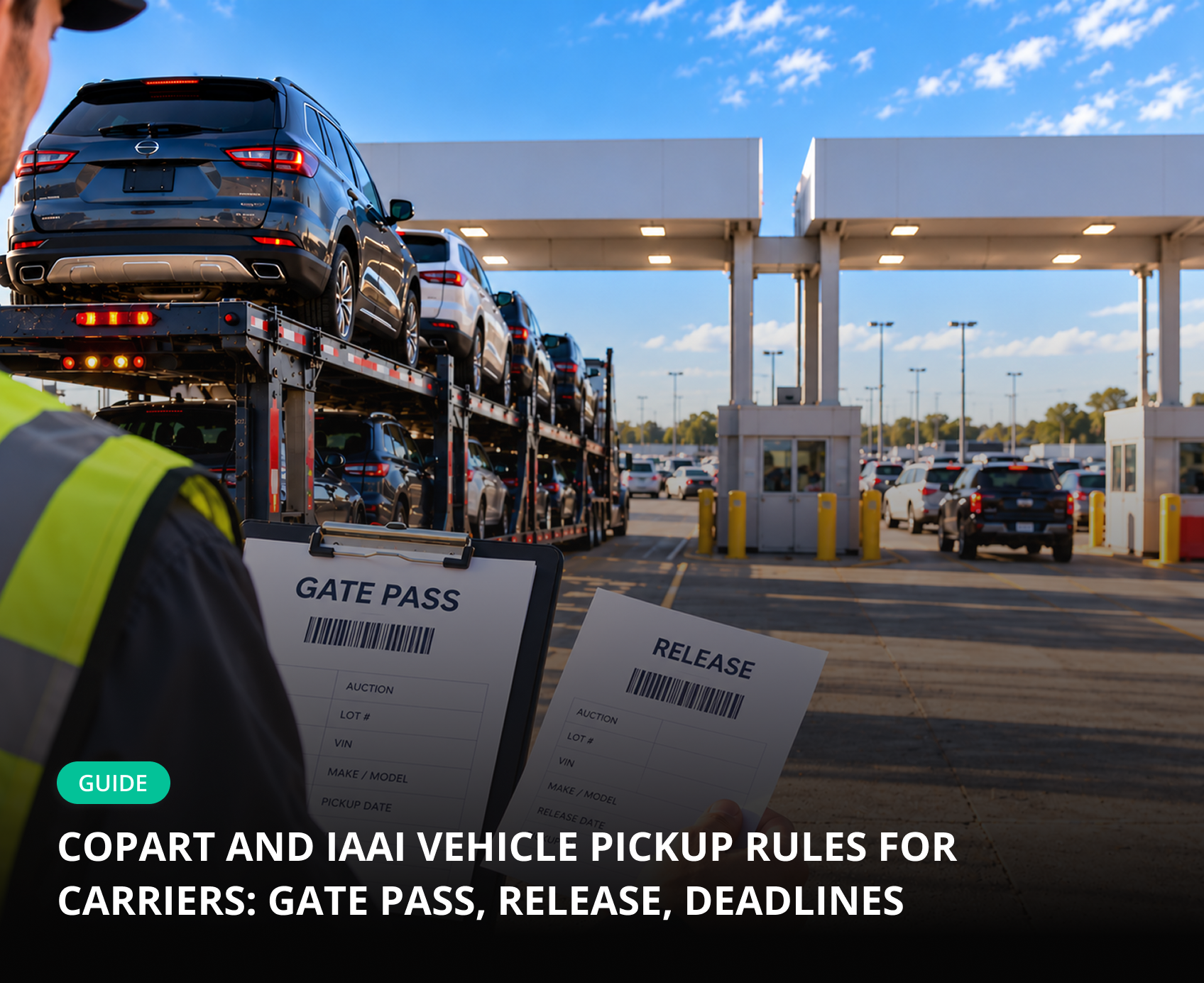
A Copart pickup or an IAAI pickup is never just "send a truck to the yard". Before a driver can load a lot, the buyer must pay the invoice, the auction must release the vehicle, and the carrier must arrive with a valid Copart gate pass or IAAI pickup PIN before the free storage window closes. Miss any one of these steps and the trip turns into a dry run, a daily storage fee, or both.
This guide is written for carriers, dispatchers and dealers who move auction vehicles every week. You will see how payment and release work at both auctions, how the Copart gate pass PIN and IAAI pickup PIN reach the driver, what happens at check-in and loading, which problems cause most failed pickups, and how to keep every purchase pickup-ready.
Why Pickup Rules Matter for Carriers, Dispatchers and Dealers
Pickup rules decide who pays for lost time. The auction does not care whether the delay came from the buyer, the dispatcher or the driver: the yard simply refuses entry or starts charging storage. For a carrier, a refused gate means an empty trip and a lost slot on the route.
Each side carries its own risk. The buyer controls payment and release documents. The dispatcher controls timing and driver assignment. The carrier controls equipment and arrival. When one link is weak, the cost lands on everyone, and most disputes start with the question "who was supposed to send the PIN?".
Here is what a broken pickup usually costs in practice:
- a dry run fee charged by the carrier, often in the range of $150–250 depending on distance and the carrier's terms;
- daily storage fees at the yard once the free period ends;
- a missed port cut-off or container slot for export shipments;
- extra dispatcher hours spent on calls and rescheduling.
On a fleet of 20–50 lots a month these costs add up fast, so experienced teams treat pickup as a process with owners and deadlines, not a last-minute errand.
What Happens After the Auction: Payment, Release and the Pickup Window
After the hammer falls, the auction issues an invoice with the bid, buyer fees and other charges. Payment must arrive within a short deadline, usually measured in business days. Only after the funds clear does the auction release the vehicle, and only then can the buyer generate a gate pass or pickup PIN for the carrier.
The pickup window starts running from the sale date, not from the payment date. This detail surprises many new buyers: if payment takes two days to clear, the carrier has less time to reach the yard, not more. Weekends and holidays may or may not count, depending on the auction and the specific branch.
Copart Pickup Deadlines and Storage Fees
At Copart, payment is typically due within two to three business days of the sale. Many yards allow roughly three free days for removal, counting the sale day, before a daily storage fee starts. The exact Copart pickup deadline and the daily rate depend on the yard and vehicle type and are shown in the buyer's account and on the invoice.
Late payment may also trigger a separate late fee. A carrier cannot remove the lot until every outstanding charge, storage included, is paid by the buyer, so after a long delay the dispatcher should confirm a zero balance before the truck leaves.
IAAI Pickup Deadlines and Storage Fees
IAAI follows a similar logic: pay within the stated deadline, then remove the vehicle within the free period before storage charges begin. Free days, daily rates and the treatment of weekends vary by branch, so the dispatcher should check the specific location rather than rely on another yard's rules.
The table below compares the main pickup points at both auctions:
| Parameter | Copart | IAAI |
|---|---|---|
| Release condition | Invoice paid in full, funds cleared | Invoice paid in full, funds cleared |
| Driver access | Gate pass / gate pass PIN from the buyer | Vehicle pickup PIN from the buyer |
| Typical free window | About 3 days incl. sale day (varies by yard) | Set by branch, check the location |
| After the window | Daily storage fee per vehicle | Daily storage charges per vehicle |
| Carrier tools | Buyer account, yard check-in | IAA Buyer App, IAA Tow App |
Treat the table as a starting point: both auctions update their terms, and local yards add their own rules on hours, safety equipment and loading.
Copart Gate Pass: How It Works for Carriers
A Copart gate pass is the release document that authorizes a specific carrier to enter the yard and remove a specific lot. The buyer generates it in their Copart account after the invoice is paid. It contains the lot number and a gate pass PIN, which the driver presents at the gate to receive the vehicle.
How the Buyer Generates and Shares the Gate Pass PIN
The process is short, but the order matters. A gate pass cannot be created for an unpaid lot, and it must point to the carrier who will actually arrive.
The standard sequence for a Copart release looks like this:
- The buyer pays the invoice and waits for the payment to post.
- The buyer opens the won or paid vehicles section of the account and generates the gate pass.
- The buyer enters or confirms the transporter details if the yard requires them.
- The buyer sends the gate pass PIN and lot number to the dispatcher in writing.
- The dispatcher forwards the PIN, yard address and hours to the assigned driver.
Send the PIN in writing, not by phone: a message record settles most disputes about a refused gate or a dry run.
Carrier Registration and Driver Requirements at Copart Yards
Copart yards expect the driver to arrive with the gate pass PIN, a valid photo ID and transport equipment that matches the vehicle condition. Some locations require pickup appointments booked in advance, and many enforce safety rules such as closed-toe shoes or high-visibility vests on the lot.
Drive-offs are generally not allowed, so every vehicle leaves on a trailer or tow truck. Commercial carriers should also keep insurance and authority documents at hand, because yard staff may verify the company before releasing the lot.
IAAI Vehicle Release: Pickup PIN, IAA Buyer App and IAA Tow App
IAAI vehicle pickup works through a pickup PIN that the buyer receives after payment. The buyer shares the PIN with the transporter, and the driver uses it at the branch to release the vehicle. Without a valid PIN tied to a paid lot, the yard will not load the car.
The IAA Buyer App lets the buyer pay, view purchases and manage pickup details from a phone. The IAA Tow App is built for transport partners: it sends dispatch notifications, supports transporter registration and check-in, and lets drivers record inspection photos and scan the VIN at pickup.
The IAAI pickup PIN should be treated like a key to the vehicle. Share it only with the assigned carrier and re-issue it if the job is reassigned to another company.
At the Yard: Check-In, Loading and Vehicle Inspection
At arrival, the driver checks in at the office or kiosk, presents the PIN and ID, and waits for the vehicle or directions to the loading zone. Loading areas often close earlier than the office, so a driver who arrives 30 minutes before closing may still be turned away.
Loading Non-Running Vehicles: Forklift, Winch and Flatbed
Many auction lots are salvage vehicles that do not start or roll. Some yards load with a forklift, but queues, weight limits and damage liability vary, so the carrier should not count on it. A flatbed or trailer with a working winch, wheel skates and enough straps is the safe default for any lot marked as non-running.
Documenting Damage Before Leaving the Lot
Before the vehicle leaves the yard, the driver should photograph it from all sides, including the roof, interior, odometer and VIN plate. Existing damage must be noted on the Bill of Lading, which the yard representative or the driver signs at pickup.
Before signing the Bill of Lading, the driver should check:
- the VIN on the vehicle matches the VIN on the pass and invoice;
- keys are present if the listing says they are;
- visible damage matches the auction photos;
- loose parts are secured or listed separately.
This takes ten minutes and protects the carrier from claims for damage that existed at the auction. Without dated photos and a marked Bill of Lading, it is hard to prove where the damage happened.
Common Pickup Problems: Dry Runs, Mismatched Passes and Storage Delays
A dry run happens when a truck reaches the yard but cannot load. The most common causes are an unpaid balance, a lot not yet released, a PIN shared with the wrong company or a non-running vehicle the driver cannot load.
A mismatched pass is the second classic problem. If the gate pass names one transporter and another company arrives, the yard may refuse the pickup until the buyer updates the release. Storage delays usually come from slow payment or late dispatch.
Dispatcher checklist before sending a truck:
- Invoice paid and funds posted.
- Lot shows as released, balance at zero.
- Gate pass or pickup PIN issued to the correct carrier.
- Yard hours and appointment rules confirmed.
- Vehicle condition known and equipment matched.
- Free window end date written in the job notes.
Example. A lot sells on Tuesday with an assumed free window through Thursday. The buyer pays Thursday afternoon, and the carrier arrives the next Tuesday. Assuming weekends count and a $45 daily rate, storage adds around $180–225 before the truck even loads.
How AuctionGate Helps Track Purchases, Payments and Pickup Readiness
Most pickup failures start with missing visibility: nobody sees which lots are paid, which are still at auction and which have already left. AuctionGate connects Copart, IAAI and other auction accounts under one login and shows every purchase in a single list with its current status.
Through AuctionGate auction account management, teams generate invoices from auction data, track payment status and uploaded payment documents per lot, and link auction locations to warehouses with set pickup prices. Dispatchers see which vehicles are ready for pickup without logging into each auction separately.
AuctionGate is not a dispatch board or a carrier app. AuctionGate covers the buying side that feeds jobs.
Conclusion
Smooth auction pickups follow one rule: payment, release and dispatch must happen in sequence and on time. Paid invoice, correct PIN, right equipment and an arrival inside the free window remove most dry runs and storage charges before they appear.
FAQ:
Q1: How Many Days Do You Have to Pick Up a Car from Copart?
A: Most Copart yards give about three days to remove a paid vehicle, counting the sale day. After that, a daily storage fee applies. The exact deadline depends on the yard and is shown in the buyer account and on the invoice, so check it before you plan the route.
Q2: Can Any Carrier Pick Up a Vehicle from IAAI?
A: Only a carrier with a valid pickup PIN for a paid and released lot can load it. The buyer shares the PIN with the chosen transporter. Carriers working IAAI branches often register in the IAA Tow App to check in faster and record inspection photos.
Q3: What Happens If the Gate Pass Does Not Match the Driver?
A: The yard may refuse to release the vehicle until the buyer corrects the gate pass. The driver either waits or leaves empty, and the carrier often bills a dry run fee. Always confirm the carrier name and details on the pass before the truck goes out.
Q4: Who Pays Storage Fees at Copart and IAAI?
A: The auction bills storage to the buyer, and the lot cannot leave the yard until the full balance is paid. Buyers often pass these costs on to the party that caused the delay, so transport contracts should state clearly who pays when pickup is late.
Q5: How to Pick Up a Car from Copart If the Vehicle Does Not Run?
A: Send a flatbed or trailer with a working winch, wheel skates and enough straps. Some yards help with a forklift, but this is not guaranteed. Tell the carrier the exact vehicle condition in advance so the right truck is booked for that specific lot.