 AuctionGate.io







Copart Storage Fees and Payment Deadlines: How Dealers Avoid Late Charges
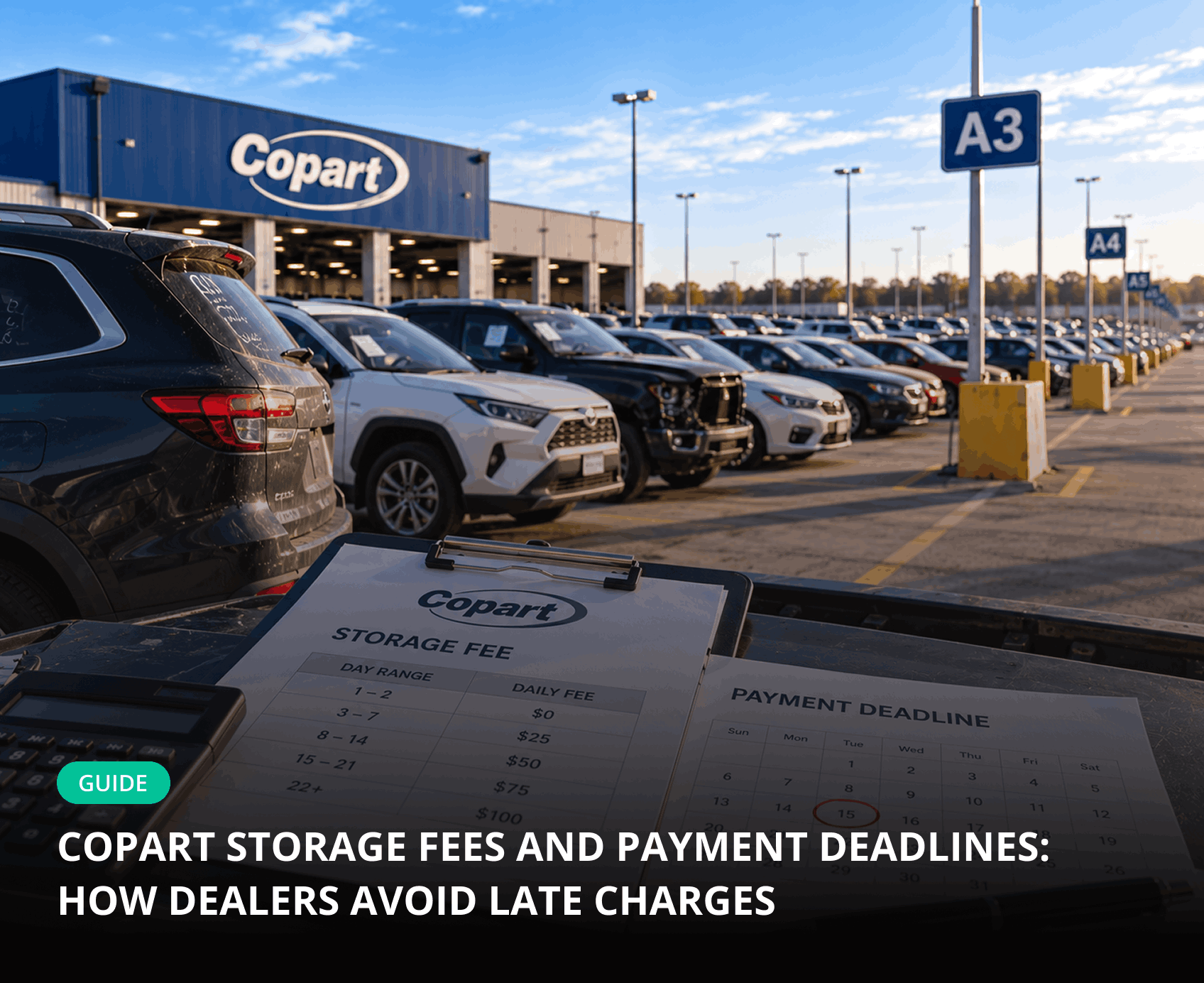
Copart storage fees and late charges are avoidable if you hit two dates: full payment within 3 business days including the day of sale, and pickup before free storage ends. Miss them, and a $50 late fee, daily storage and a relist penalty start adding up.
This guide is written for dealers and brokers who buy several lots a week. It gives you a deadline timeline, typical daily storage rates, a cost example on one car and a checklist your team can use after every win.
Why Copart Deadlines Hit Dealers and Brokers Harder Than Single Buyers
A single buyer manages one invoice and one truck. A dealer or broker runs ten or twenty lots on the same account, and every lot has its own payment clock and storage clock.
The risk is not one late fee. It is the chain reaction when money or transport is late across many cars at once.
Here is what makes volume buyers more exposed:
- Client money arrives late, but the auction does not wait for your client.
- One account carries all lots, so penalties come from one shared deposit.
- Repeated non-payment can lead to an account suspension that blocks every client.
- Several Friday wins land on the same weekend, when yards are closed.
For a broker, a missed deadline also costs trust. The client sees extra charges on the final invoice and asks why the broker did not pay on time. Clear deadlines protect both the margin and the relationship.
Copart Payment Deadline: 3 Business Days Including the Day of Sale
At most Copart US yards, the buyer must pay in full within 3 business days, and the day of sale counts as day one. Win on Monday, and payment must clear by the end of Wednesday.
Dealers often ask: how long do you have to pay Copart before the penalties start? The short answer is three business days for the $50 fee and eight calendar days before the lot is relisted. Weekends and federal holidays do not count as business days.
The timeline below shows how the dates fall for a lot won on a Thursday:
| Day | Date (lot won Thursday) | What happens |
|---|---|---|
| Business day 1 | Thursday | Day of sale, invoice appears in Payments Due |
| Business day 2 | Friday | Best day to send the wire |
| Weekend | Saturday–Sunday | Not business days, yards closed |
| Business day 3 | Monday | Last day to pay without a late fee |
| Business day 4 | Tuesday | $50 late fee added, storage usually starts |
| Calendar day 8 | Next Thursday | Unpaid lot can be relisted |
The timeline shows why a Thursday or Friday win is risky: the weekend eats two days, and the Copart payment deadline arrives on Monday. Brokers who resell access to Copart accounts may set a shorter window, often 2 business days, so check their terms too.
Late Payment Fee: $50 per Vehicle
The Copart late payment fee is a flat $50 for each vehicle that is not paid in full by the end of business day 3. It is added to the invoice and is not refunded.
Fifty dollars looks small on one lot. On twelve lots won in one week, a slow client wire turns it into $600 of pure loss. A partial payment does not stop the fee either: the invoice must be fully paid.
Relist Fee After 8 Calendar Days: 10% or $600 Minimum
If a lot stays unpaid for 8 calendar days including the day of sale, Copart can cancel the sale and put the car back up for auction. The penalty for that is 10% of the sale price, with a minimum of $600, and it is usually taken from the buyer's deposit.
Unlike the business-day count, this deadline counts weekends. The Copart relist fee also means you lose the car itself, so it is the most expensive mistake in this guide. For a full list of auction and post-purchase charges, see our breakdown of Copart fees in 2026 before planning your budget.
Payment Methods That Clear on Time: Wire Transfer, Deposit and Cards
The deadline is met when Copart receives cleared funds, not when you press "send". Choose the method by how fast the money actually lands.
A wire transfer is the standard choice for dealers. A Copart payment sent by wire before the bank's cut-off time usually clears the same or the next business day. Cashier's checks and money orders are secured funds too, but mail and processing can take two or three days.
Your security deposit is not a payment method for the car. It sets your buying power and covers penalties such as the relist fee. Credit and debit cards count as non-secured funds at Copart and usually come with a higher buyer fee schedule, so check the cost before you use them.
Storage Fees at Copart: Free Days, Daily Rates and Weekends
Copart gives a short free storage period, then charges a daily fee until the car leaves the yard. At most yards, the free period matches the payment window: 3 business days including the day of sale.
Storage and payment are separate clocks. Paying on time does not stop storage, and only pickup does. A lot paid on day 2 but collected on day 9 still pays for several days of storage.
Pickup also depends on paperwork. The gate pass becomes available only after the funds clear, and the carrier cannot enter the yard without it. Every hour between payment and dispatch eats into the free days.
When the Storage Clock Starts: Online Bids vs Buy It Now
For online auction lots, the storage clock starts on the day of sale, not on the day you pay. A Buy It Now purchase works the same way: the day you click "Buy It Now" becomes the sale date, and both clocks start that day.
Lots sold on seller approval are the exception. Their sale date is usually the day the seller accepts your bid, which can come a day or two later. Always check the sale date printed on the invoice instead of counting from the auction day.
Copart Storage Fees per Day and Where to Find Your Yard's Rates
Copart does not publish one national rate. Each yard sets its own daily storage fee, shows it on the location page and adds it to the invoice.
Carriers and brokers report rates in roughly these ranges:
| Yard type | Typical daily rate | 5 extra days |
|---|---|---|
| Small or rural yard | $10–$30 | $50–$150 |
| Regional yard | $25–$50 | $125–$250 |
| Busy metro yard (CA, NY, FL) | $40–$85 | $200–$425 |
| Heavy or oversized vehicle | Higher, set by yard | Ask the yard |
Treat these numbers as a planning guide, not a quote. Before bidding in a new location, open the yard page and note Copart storage fees per day for that exact address.
Do Weekends and Holidays Count Toward Storage?
Yes, once paid storage has started. Weekends and holidays usually do not count toward the free business days, but every calendar day after the free period is billed.
The problem is that most Copart yards do not release vehicles on Saturday and Sunday. A car whose free period ends on Friday will collect storage over the weekend even if your truck is ready.
Federal holidays work the same way. Around Thanksgiving, Christmas and New Year, yards close or shorten hours, and carriers are booked out. Plan pickups for lots won in late November and December a few days earlier than usual.
Example: What Late Payment and Late Pickup Cost on One Lot
Here is a realistic case for a dealer who buys a 2018 Honda Accord Sport for $6,400 at a regional yard with a $45 daily storage fee.
The lot is won on Thursday. The client sends money on Monday afternoon, so the dealer's wire reaches Copart on Tuesday. The carrier is booked late and picks the car up the following Monday.
| Cost item | How it is calculated | Amount |
|---|---|---|
| Late payment fee | Paid on business day 4 | $50 |
| Storage | 7 calendar days, Tuesday to Monday, × $45 | $315 |
| Total avoidable cost | Late fee plus storage | $365 |
| If unpaid by next Thursday | Copart relist fee: 10% of $6,400, above the $600 minimum | $640 and the car |
In this case the $50 late fee is the smallest line. Storage cost six times more, and it grew because the carrier was booked only after the payment cleared.
The dealer paid $365 for a two-day delay in client money and a slow dispatch. Across 10 similar lots a month, that is $3,650 that never reaches the profit line.
Why Dealers Miss Copart Deadlines: Client Payments, Wires and Too Many Lots
Most late charges come from process gaps, not from careless buyers. The money exists, but it moves too slowly between the client, the dealer and Copart.
These are the gaps we see most often:
- The dealer waits for the client's money before paying the auction.
- A wire is sent after the bank's daily cut-off time.
- Nobody owns the invoice once the lot is won.
- Friday and holiday wins are tracked like midweek wins.
- The carrier is booked only after the funds clear.
- Too many lots sit across several accounts and spreadsheets.
Each gap adds a day. Two of them together are enough to miss the payment window and push the car into paid storage.
The worst case is a client who disappears after the win. If nobody notices for a week, the relist penalty comes out of the dealer's deposit, not the client's pocket. Ask for a prepayment or a client deposit before bidding on expensive lots.
Multiple accounts make it harder. A dealer who bids through two or three buyer accounts has to check each one separately, and an unpaid lot on the second account is easy to miss.
How to Avoid Copart Late Charges: A Checklist for Dealers
The safest system is simple: pay from your own funds first, then collect from the client. Keep a cash buffer that covers at least one week of typical purchases, so a slow client never decides when Copart gets paid.
When a new manager asks, "How long do you have to pay Copart?", the answer should already sit next to every lot. Use this checklist after every win:
- Open the Payments Due page on the day of sale and note every new invoice.
- Write the business-day 3 date and calendar-day 8 date next to each lot.
- Send the client an invoice within an hour of the win.
- Wire the full invoice amount by business day 2, before the bank cut-off.
- Confirm cleared funds, then generate the gate pass for pickup.
- Book the carrier the same day and confirm the yard's opening hours.
- Check the yard's daily storage fee for lots that may arrive late.
- Review all unpaid lots every morning until each car leaves the yard.
A dealer who follows these steps rarely pays a late fee. The checklist works best when one person owns it and the whole team sees the same lot status.
How AuctionGate Push Notifications Help Dealers Avoid Late Charges
The main reason for late charges is delay: the team learns about a win or an unpaid invoice too late. AuctionGate removes that delay with push notifications in the mobile app.
The app (Bidder Tool for iOS, AuctionGate for Android) sends push notifications about won lots and payments. Your manager sees a win the moment it happens and can start the Copart payment the same day.
The system also creates an invoice for the client automatically when a lot is bought. In the web dashboard, the Unpaid tab shows every lot still waiting for payment and the total amount to collect. With auction account management in one place, you can also cap each client's active lots and total bid amount.
If you buy one car a year, a calendar reminder is enough. For a dealer handling dozens of lots a month, instant alerts and one view of unpaid lots stop late fees before they appear.
Conclusion
Late charges at Copart follow a fixed timeline. The $50 fee starts after business day 3, storage starts after the free days, and the relist penalty arrives on calendar day 8.
Dealers and brokers stay ahead by paying from their own funds, wiring early and booking pickup on the day of sale. A short daily review of unpaid lots catches the rest.
Even a careful team can lose track across many accounts and clients. Tools like AuctionGate bring wins, invoices and payment status into one view, so every deadline is visible before it costs money.
FAQ:
Q1: What Happens If You Pay Copart Late but Before Day 8?
A:You keep the car, but you pay extra. The Copart late payment fee of $50 is added once business day 3 has passed, and daily storage usually starts the next day. The sale is not cancelled while the invoice is paid within 8 calendar days, counting the day of sale. Pickup is possible only after the funds clear.
Q2: Does Paying for a Lot Stop Storage at Copart?
A:No. Payment stops the late fee clock, but storage runs until the vehicle physically leaves the yard. A lot paid on time can still collect several days of storage if the carrier arrives late. Book transport on the day of sale, and confirm the yard's hours before the truck goes out.
Q3: How Much Does Copart Charge for Storage per Day?
A:There is no single national rate. Each Copart yard sets its own daily charge and shows it on the location page and the invoice. Carriers report roughly $10–$30 at small yards and $40–$85 at busy metro yards. Heavy or oversized vehicles usually cost more, so check the yard before you bid.
Q4: What Happens If You Never Pay for a Car You Won on Copart?
A:After 8 calendar days without full payment, Copart can cancel the sale and relist the car. The buyer is charged 10% of the sale price, at least $600, usually from the security deposit. Repeated non-payment can lead to account suspension, which blocks bidding for every client on that account.