 AuctionGate.io






US Auction Cars to Iraq: Routes via Dubai and Umm Qasr, Costs and Documents
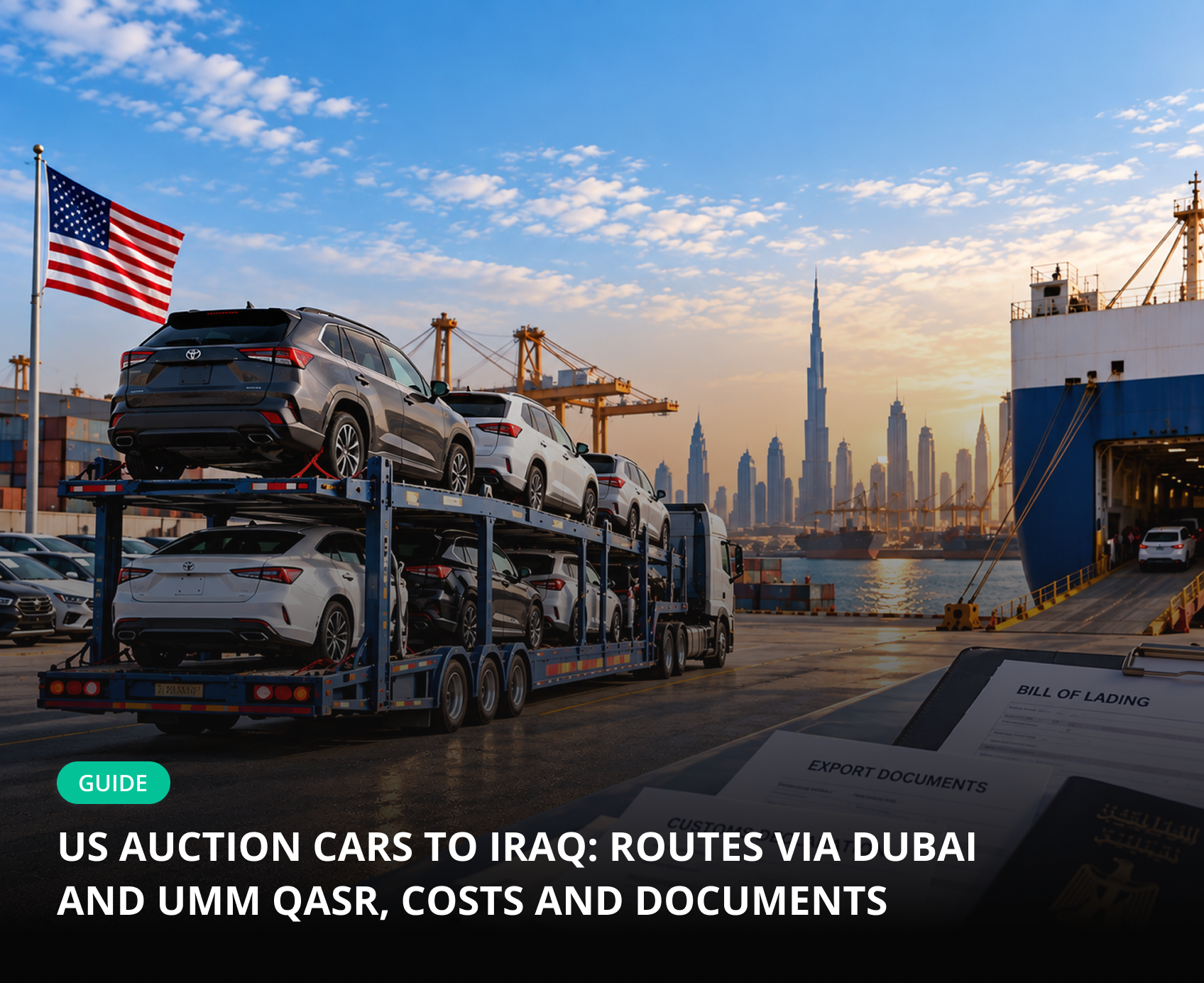
American cars in Iraq arrive by two sea routes: direct from a US port to Umm Qasr near Basra, or through Jebel Ali in Dubai. The direct route is simpler and usually cheaper. Dubai suits cars that need repair first. Since 2026, burned and flooded cars cannot enter Iraq.
This guide is for Iraqi dealers who buy on Copart and IAAI. It compares both routes, costs, transit time and the papers customs will ask for.
Why American Cars Are in Demand in Iraq
Iraqi buyers choose US auction cars because they cost less than the same models sold new in the country. In Basra, importers reported savings of $5,000 to $8,000 per car in 2024. Most of those imports were priced between $15,000 and $20,000.
Copart is the auction brand most Iraqi buyers know by name. Copart Iraq agent offices in Basra, which bid for local clients, grew from a handful in 2020 to hundreds by 2024, according to auction house owners interviewed by bne IntelliNews. Dealers there reported buying up to 1,500 cars a month online.
Buyers ask most for the Hyundai Elantra and Sonata, Dodge Charger and Challenger, and Jeep SUVs. A clean title lot resells fast, while repairable salvage cars give a bigger margin and more risk at the port.
Iraq is one of several Middle East buyers of these cars. For a wider picture of where US lots go, read our overview of top countries importing US auction vehicles in 2026, which also covers the UAE as a re-export hub.
Iraq Import Rules in 2026: What You Can and Cannot Bring In
From 1 January 2026, every car entering federal Iraq must meet the national vehicle standard of the Central Organization for Standardization and Quality Control (COSQC). Cars are inspected at the port and released only if they comply. The rule covers any import car from USA to Iraq, whichever auction sold it.
Damaged, Flood and Fire Vehicles: Entry Restrictions
Burned, flooded and severely damaged used cars are banned from Iraq. In November 2025 the head of COSQC said such cars would not be admitted at all from 2026, whatever their country of origin.
For Copart Iraq buyers this changes the math of bidding. A lot listed with flood or fire damage is now a loss, even at a very low price. Cars after serious accidents also fall under the wording, so heavy structural damage is a red flag.
Lots with light body damage and a repairable salvage document are still traded every week. The final decision, however, belongs to the inspector at the port. Before bidding, filter out these lot types:
- Primary or secondary damage marked as water or flood
- Any burn damage, including engine or interior fire
- Frame, undercarriage or rollover damage visible in the lot photos
- Documents marked parts only, non-repairable or certificate of destruction
These filters take a minute and save paying ocean freight for a car that will be stuck at the port.
Iraqi Vehicle Standards, Model Year Limits and Kurdistan Region Rules
Federal rules focus on conformity with COSQC technical requirement No. 167. Model-year limits are set and changed by government decisions, so confirm the current cut-off with your broker before bidding on an older car.
The Kurdistan Region applies its own list. For 2026 the KRG Ministry of Interior banned burned and submerged cars, right-hand drive vehicles and low-model cars. Imports also need a Certificate of Conformity, and hybrid and electric cars are exempt from customs duty in Kurdistan.
For buyers in Erbil this means a double check: an older model can clear Umm Qasr and still fail KRG registration.
Route 1: Direct Shipping from the US to Umm Qasr
Direct shipping means the car is loaded at a US port and booked through to Umm Qasr, the main port of Iraq. It is the simplest option for cars without serious damage.
Most forwarders that ship car to Umm Qasr on a through booking use container shipping. Three or four cars share one 40-foot container, which lowers the cost per unit. The container usually changes vessels at a Gulf hub on the way.
RoRo (roll-on/roll-off) is often cheaper per car, but it takes only running vehicles, and options to Umm Qasr are limited. That is why most quotes for auction cars come in containers.
The direct route usually runs in this order:
- A truck collects the car from the Copart or IAAI yard after payment.
- A warehouse in New Jersey, Savannah or Houston loads it into a container.
- The forwarder files export data in AES and presents the title to US customs.
- The container sails to Umm Qasr, usually with one transshipment.
- A broker in Iraq clears the car and books a truck to the buyer.
Fewer handovers mean fewer delays. A typical import car from USA to Iraq spends 4 to 8 weeks between the US port and Umm Qasr on this route.
Route 2: Through Dubai (Jebel Ali) to Iraq
The second route sends the car to Jebel Ali in Dubai first and then on to Iraq. It makes sense when the car needs repair or no direct sailing fits the schedule.
Shipping lines call at Jebel Ali much more often than at Umm Qasr. An October 2026 forwarder rate for a shared container from New Jersey to Jebel Ali was about $1,350 per car, plus UAE port charges. Transit from US ports varies from 5 to 10 weeks.
Repair and Re-Export Through the UAE
Re-export is the main reason Iraqi importers go through Dubai. Since 2017 the UAE has refused to register salvage cars with fire, flood or non-repairable brands. Import for re-export and for parts stayed open, according to forwarders that work the route.
Workshops in Sharjah and Dubai repair the car before it moves on. Repair in the UAE does not erase the history of a car. A vehicle sold on Copart as flooded keeps that record under its VIN, and Iraqi inspectors can refuse it after a perfect repair. Use the UAE leg for crash damage, not for flood or fire lots.
From Jebel Ali to Umm Qasr by Sea or by Land
By sea, the leg from Jebel Ali is short. The RoRo freight link between Jebel Ali and Umm Qasr, launched by DP World in 2023, takes about 36 hours of sailing. Booking and port handling add several days on top.
In October 2026 the state-owned Iraqi Line resumed container sailings from the UAE to Umm Qasr after decades of pause. Forwarders who ship car to Umm Qasr from Dubai now have more sailings to choose from.
By land, trucks carry cars from the UAE through neighbouring Gulf states. The road trip can take up to 14 days with border waiting, so it suits only small urgent batches.
Shipping Costs and Transit Times from the US to Iraq
A typical quote for "shipping car to Iraq" from a US forwarder covers only the ocean leg. For a shared container to Umm Qasr it is usually $1,700 to $2,500 per car, based on public forwarder rates for 2024 to 2026.
The table compares indicative ranges per car. Rates change with the season and the port of loading:
| Route stage | Method | Cost per car, USD | Transit time |
|---|---|---|---|
| US East Coast to Umm Qasr | Shared 40 ft container | 1,700–2,500 | 4–8 weeks |
| US port to Jebel Ali | Shared 40 ft container | 1,350–1,800 plus UAE port fees | 5–10 weeks |
| Jebel Ali to Umm Qasr | RoRo or feeder vessel | 800–1,800 | 36 hours at sea plus handling |
| UAE to Iraq | Truck by road | On request | Up to 14 days |
| Umm Qasr clearance | Broker, handling, inspection | 450–1,150 | 4–10 working days |
The direct route is usually cheaper and faster for a car that runs. The Dubai route wins only when a repair in the UAE adds more value than the extra leg costs.
Here is a simple landed-cost example for cars from America to Iraq. A 2020 Dodge Charger costs $12,000 at auction, fees included. Add $500 of US towing, $2,000 of container freight, about 15% duty and $700 of port fees. The car lands at roughly $17,400 before repair.
Documents for Shipping a US Auction Car to Iraq
Every shipment needs two sets of papers: US export documents and Iraqi import documents. A missing paper on either side stops the car at the port.
Use this checklist for each car:
- Original title or salvage certificate sent by the auction after payment
- Bill of Sale from Copart or IAAI with the buyer's name
- Commercial invoice showing the price paid at the auction
- AES filing confirmation with the ITN number from the US forwarder
- Bill of Lading naming Umm Qasr as the port of discharge
- Certificate of Conformity where required, including in the Kurdistan Region
Keep the VIN identical on every document: one wrong digit can hold a car at the port for days.
US Export Documents: Title, Bill of Sale and AES Filing
US Customs and Border Protection needs the original title, or a certified copy, and the car itself at least 72 hours before export (19 CFR Part 192).
AES is the Automated Export System for export filings. Used vehicles must be filed at any value, unlike most goods with a $2,500 threshold. The forwarder files it and gets an ITN number.
Some non-repairable auction documents block export or add fees. Check the document type against the list of exportable / non-exportable titles before you place a bid, not after you win.
Customs Clearance at Umm Qasr: Duties and Taxes
Iraq charges duty on the price plus freight and insurance. Under Cabinet Decision No. 957 of October 2025, cars are usually taxed at 8% to 15% by engine size and model year.
The tariff is still disputed in parliament, and brokers quote higher rates for large engines. Ask for the current rate on the exact VIN before the car sails, since duty is the biggest line in a "shipping car to Iraq" budget.
Clearance at Umm Qasr usually takes 4 to 10 working days with complete documents.
Common Mistakes When Buying US Auction Cars for Iraq
Most losses on Iraqi imports come from decisions made before the bid, not during shipping.
The most common mistakes are:
- Bidding on flood or fire lots that cannot enter Iraq after 2026
- Ignoring the document type until the car is already paid for
- Forgetting the 72-hour title rule and missing the planned vessel
- Selling US-spec cars without checking cooling for the Iraqi summer
- Buying for Kurdistan without checking KRG model and registration rules
Many US auction cars to Iraq sit in port storage because of one of them, not because of a lack of buyers.
How AuctionGate Delivery Price Lists Show the Cost to Iraq
The hardest part of selling cars from America to Iraq is giving a full price before the bid. Calculating car, fees, freight, port and duty by hand for every lot leads to mistakes.
AuctionGate solves this with personal delivery price lists. A logistics company or dealer builds each delivery price list along the chain: auction, warehouse, freight, port, truck and customs. Prices can differ by vehicle type, such as sedan, SUV, pickup or motorcycle.
For Iraq, you can keep separate price lists by direction: New Jersey to Umm Qasr in a container, or Houston to Jebel Ali with onward delivery. Each client sees only their own prices, and lists import from Excel or export as a PDF.
The AuctionGate Chrome extension shows the full cost right on the Copart or IAAI lot page, using the client's own price list. It also shows the document type and whether the car can be exported. A dealer in Basra sees the landed price in about 30 seconds.
If you buy one car a year, a spreadsheet is enough. A team that buys weekly pays only for purchased lots, with 14 days free.
Conclusion
Most American cars in Iraq come from US auctions by one of two sea routes. Direct container shipping to Umm Qasr is the default for running cars with clean or repairable documents. The route through Jebel Ali fits cars that need repair in the UAE or have no direct sailing.
The 2026 rules move the main risk to the bidding stage. Flood and fire lots are out, document types must be checked in advance, and Kurdistan adds its own list. Dealers who check these points and quote a full landed price win on margin, not on luck.
FAQ:
Q1: Can I import a salvage title car from Copart to Iraq in 2026?
A: Yes, if the damage is repairable and was not caused by fire or flood. Iraq bans burned, submerged and severely damaged used cars from 2026. A salvage car with light body damage can still clear customs, but the inspector at Umm Qasr makes the final decision.
Q2: How long does it take to ship a car from the USA to Iraq?
A: Usually 4 to 8 weeks from the US port to Umm Qasr on a direct container booking. Add about a week for towing to the US port and 4 to 10 working days for clearance in Iraq. The route through Dubai usually takes longer because of the extra leg.
Q3: Do Kurdistan Region import rules differ from federal Iraq rules?
A: Yes. The Kurdistan Region publishes its own list of import rules. For 2026 it bans burned and submerged cars, right-hand drive vehicles and low-model cars, and it frees hybrid and electric cars from duty. A car must pass both the federal port checks and KRG registration.
Q4: How long does customs clearance at Umm Qasr take?
A: Usually 4 to 10 working days when all documents are complete and the VIN matches on every paper. Errors in the title, invoice or Bill of Lading add days, and storage charges start after the free period. A local broker who knows the port speeds up the process.