 AuctionGate.io







Top Countries Importing US Auction Vehicles in 2026: Market Overview
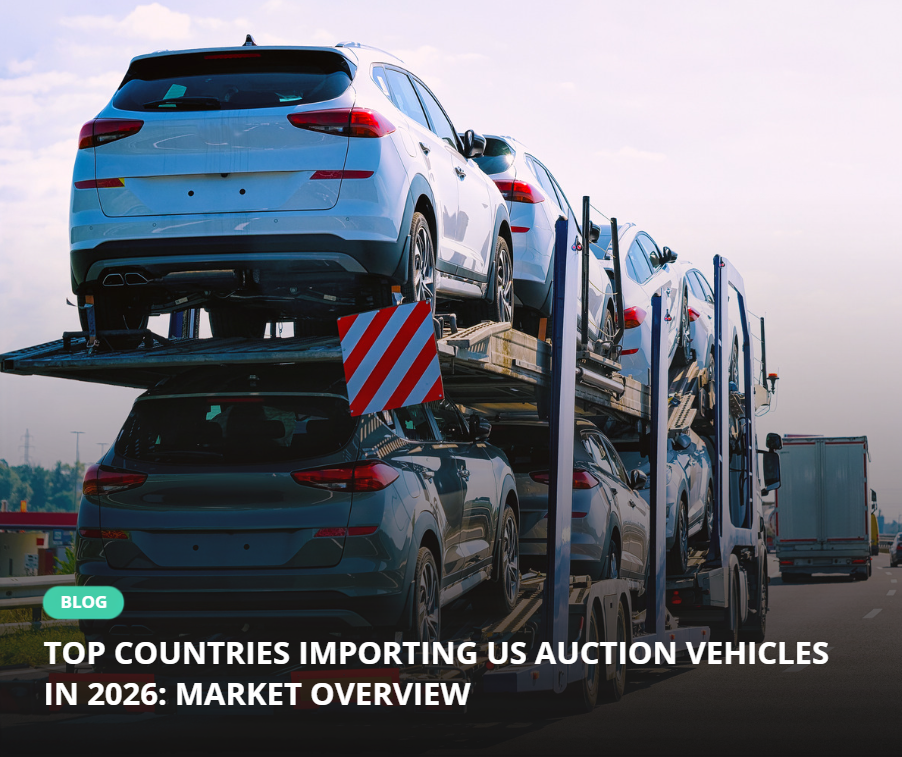
International demand for Copart and IAAI vehicles keeps growing. Copart alone attracts bidders from more than 190 countries, and international buyers now drive roughly 90% of all bidding activity, walking away with close to 30% of everything sold. This guide breaks down where those cars go in 2026 — country by country, region by region — and what dealers sourcing across multiple markets need to know about demand, logistics, and shipping method.
Why US Salvage & Used Car Auctions Attract Global Buyers
The math is simple: American auction inventory is deep, damage-graded, and priced well below retail in almost every destination market. A dealer in Guatemala buying through Copart typically pays 25–30% less than the local market price, because Copart's sheer volume — dozens of the same model at once — keeps competition, and prices, in check.
Three other factors reinforce that price gap. Condition transparency: every lot lists damage type, odometer reading, and salvage title status, so a bidder overseas can evaluate a car almost as well as someone standing in the yard. Sheer scale: Copart moves close to 3–4 million vehicles a year and IAAI around 2–2.5 million, so buyers can source specific models at volume instead of hunting one car at a time. And age: most exported units are 3–5 years old, giving importers modern safety and tech features at a fraction of new-car pricing — a sweet spot that keeps repair shops, dealers, and exporters coming back weekly.
Top Import Markets for Copart and IAAI Vehicles in 2026
Containerized car exports from US ports rose sharply through 2025- 2026, and the country mix shifted noticeably. Estimated US car exports reached roughly 779,000 units in the first seven months of 2025 versus about 668,000 a year earlier — a 16.7% increase — with the top ten destination countries absorbing 55.1% of total volume. Here's how that demand breaks down by region.
Eastern Europe & the Caucasus (Ukraine, Georgia, Poland, Lithuania)
Georgia and Lithuania are two of the fastest-growing destinations for US auction vehicles anywhere in the world. Georgia's Poti port functions as a regional import hub, re-distributing vehicles further into the Caucasus and Central Asia — part of why its volumes keep climbing.
Ukraine remains a steady buyer despite wartime disruption to shipping routes; imported American cars there skew young, averaging about 5.8 years old, with growing EV demand including the Tesla Model 3. Poland absorbs a large share of Copart and IAAI export volume through its own broker networks, feeding domestic resale and re-export further into the EU. Lithuania and the Baltic corridor increasingly serve as a transshipment gateway for buyers who want EU customs clearance before moving vehicles onward.
Middle East & Africa (UAE, Saudi Arabia, Nigeria)
The UAE is less a single destination than a regional distribution engine: cars land in Dubai or Sharjah and get re-exported across the Middle East and East Africa. Nigeria has become one of Africa's largest buyers of used vehicles, driven by affordability and demand for spare parts.
Nigeria's growth has been especially sharp — one of the standout risers in 2025 export data, alongside Libya, on strong demand for both drivable cars and parts-only salvage units. Saudi Arabia rounds out the region as a steady, high-volume buyer of clean and lightly damaged units, with strong demand for larger SUVs and trucks.
Latin America (Mexico, Guatemala, Dominican Republic)
Mexico is the single largest buyer relationship the US auction industry has, helped by geographic proximity and integrated trade infrastructure — trucking a car south is often cheaper than shipping one anywhere else. Free trade agreements reinforce it, making Mexico a natural, high-volume buyer.
Guatemala's importers lean heavily on Copart for the depth of inventory: where the local market might have two of a given model, Copart might list a hundred, keeping landed prices competitive even after transport and customs. The Dominican Republic remains one of the steadiest Caribbean buyers of US salvage and clean-title units, typically moved by container shipping rather than RoRo given local port infrastructure.
Central Asia (Kazakhstan, Kyrgyzstan)
Central Asia is the least-tracked region in public export data, but the trend is upward. Growth rides largely on Georgia's role as a transshipment point — vehicles land at Poti, clear customs, and move onward by road or rail into Kazakhstan and Kyrgyzstan rather than shipping directly. Country-level volume figures for this corridor are harder to source publicly than for the other three regions, so dealers active here should treat published totals as directional and lean on broker data for planning.
What Drives Import Demand: Price, Vehicle Condition, Logistics
Three variables decide where volume flows: price, vehicle condition, and shipping cost. Price is the obvious driver — auction pricing consistently undercuts retail by 25–40%, enough to make even a damaged car with repair costs a better deal than a comparable clean unit bought locally.
Vehicle condition determines which countries buy which lots. Markets with strong local repair capacity — Georgia, Poland, Nigeria — absorb more salvage-title and flood-damage units, since a competent body shop can restore resale value cheaply. Markets with tighter damage rules or higher repair labor costs skew toward clean-title and lightly damaged lots instead.
Logistics is the swing factor. RoRo shipping is cheaper per unit for drivable vehicles and dominates lanes to West Africa and parts of the Middle East, while container shipping suits non-runners, high-value vehicles needing theft protection, or ports with limited RoRo infrastructure — most routes into the Caucasus, the Baltics, and the Caribbean. A dealer running volume across several countries usually needs both, since the right method changes by destination, not vehicle type alone.
2026 Export Volume and Market Trends
Overall containerized car export volume from the US grew roughly 17% year-over-year through mid-2025, and early 2026 data suggests that momentum has largely held. A few trends stand out for 2026 planning:
- Regional concentration is increasing. The top ten destinations now account for more than half of all export volume — demand is consolidating into fewer, high-growth corridors.
- Nigeria, Georgia, and Lithuania are the standout risers, while several traditional EU lanes — Spain, Belgium, parts of Germany — have softened amid shifting trade relations and tariffs.
- EV demand is emerging, most visibly in Ukraine, though volumes stay small relative to gasoline models.
- Age profile is stable. Most exported US vehicles are still 3–5 years old, keeping the "near-new at a discount" pitch intact everywhere.
For dealers, growth markets (Georgia, Nigeria, Lithuania) reward buyers who move fast and lock in shipping space early, while mature markets (Mexico, the UAE, Poland) reward those who operate at consistent volume rather than chasing single lots.
How AuctionGate Helps Dealers Manage Multi-Country Purchases
Running purchases across four or five markets at once creates a coordination problem before it becomes a shipping one: which manager bought which lot, which country it's headed to, and which invoice is still open. AuctionGate solves that by putting every auction account — Copart, IAAI, or Manheim — into one dashboard, so a team buying for Georgia, Nigeria, and Mexico at once sees it all in one place instead of juggling logins per market.
Bid limits and roles are set per manager, so a team spread across regions doesn't duplicate a purchase or blow a client's budget on the wrong lot. Deadlines, invoices, and shipping status are tracked centrally — which matters most exactly where growth is concentrating: high-volume corridors where a missed pickup or a mismatched destination costs real money in relist fees and demurrage.
If your team is sourcing across several of the markets covered here, AuctionGate's account management tools consolidate accounts, lots, and deadlines into one workspace. Learn more about the platform at AuctionGate.
Connect your Copart, IAAI, or Manheim account and manage every market from one dashboard.
FAQ:
Q1: Which countries import the most US auction cars in 2026?
A: Georgia, Lithuania, the UAE, Nigeria, and Mexico are among the top destinations for US auction and used-vehicle exports in 2026, alongside steady volume to Ukraine, Poland, Saudi Arabia, and the Dominican Republic.
Q2: What percentage of Copart's sales go to international buyers?
A: International bidders drive around 90% of bidding activity on Copart's platform and purchase roughly 30% of all vehicles sold, with buyers registered from more than 190 countries.
Q3: Is container shipping or RoRo shipping better for exporting auction cars?
A: It depends on the vehicle and the destination port. RoRo is generally cheaper for drivable vehicles heading to ports with RoRo infrastructure, while container shipping suits non-runners, high-value vehicles, and routes — like most of Eastern Europe and the Caribbean — where container handling is the standard or safer option.
Q4: Why is Nigeria one of the fastest-growing US car export markets?
A: Nigeria's growth is driven by strong demand for both drivable used vehicles and parts-only salvage units, combined with affordability compared to buying locally — a pattern consistent with the broader West Africa and MENA growth trend seen in 2025–2026 export data.
Q5: What's the average age of a US export vehicle bought at auction?
A: Most vehicles exported from US auctions are 3–5 years old, which gives importers modern safety and technology features at a fraction of new-car cost — in Ukraine, for example, the average age of imported American vehicles is around 5.8 years.
Q6: Do Copart and IAAI export vehicles directly, or do buyers need a broker?
A: Both platforms sell internationally, but many countries require buyers to work through a licensed broker or Market Alliance partner, especially where local licensing rules restrict direct auction access to dealers.