 AuctionGate.io







How to Decode a VIN Number for Accurate Auction Car Specs
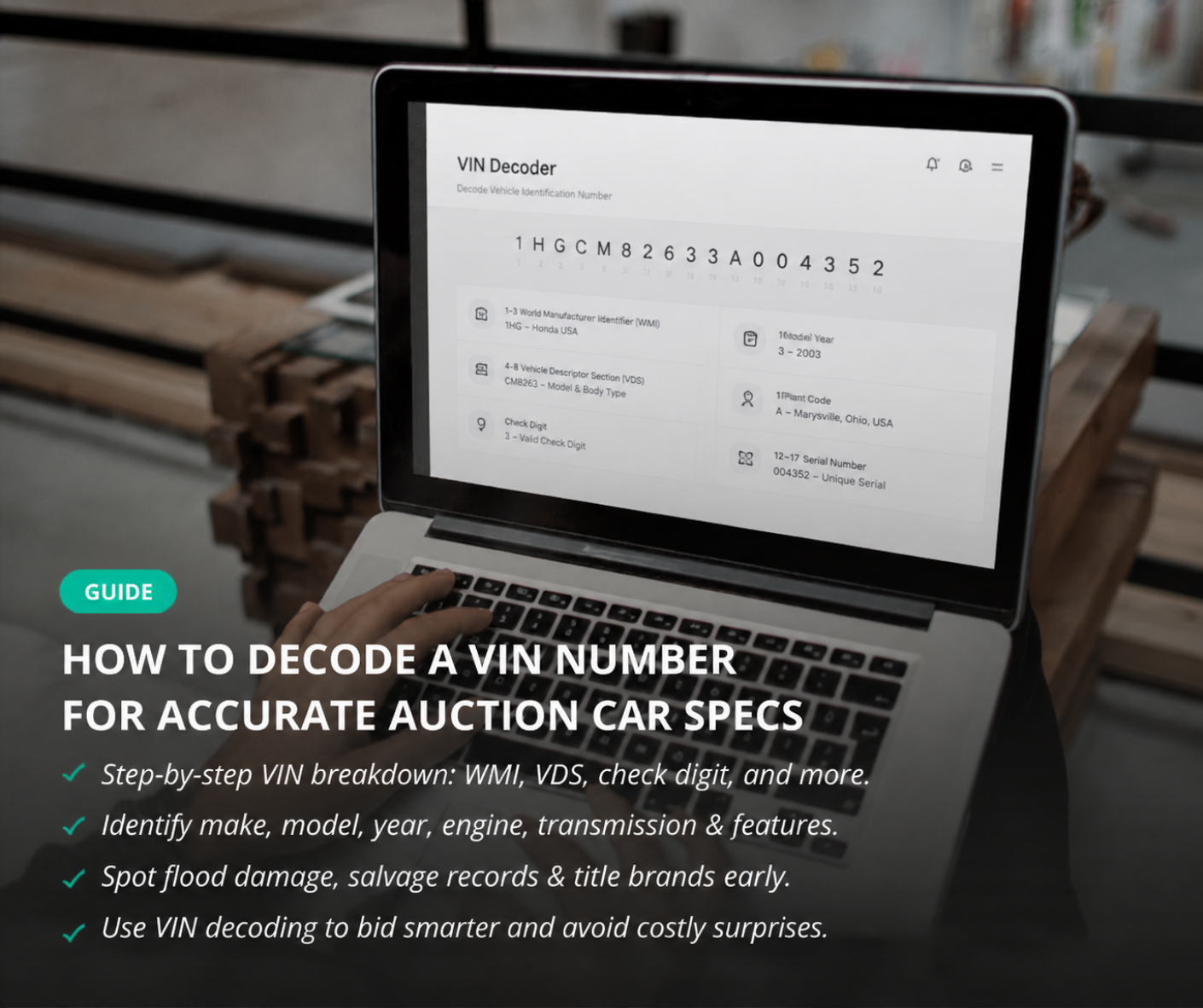
A vehicle's 17-character VIN is the single most reliable data source you have before you ever place a bid. Every listing on Copart or IAAI includes a VIN, but the auction description doesn't always tell the whole story — a VIN number decoding chart does. Learning decoding a VIN number properly means you can independently verify the engine, body style, country of manufacture, and model year printed on a lot, instead of taking the listing at face value. This guide walks through exactly how VIN number decoding works, section by section, and how to apply it specifically to auction vehicles rather than a generic used-car purchase.
Why VIN Number Decoding Matters for Auction Buyers
Auction listings are written quickly and updated by different yard staff, which means small errors — a wrong trim level, a mismatched engine size, an outdated body style — happen more often than buyers expect. Decoding VIN number data directly from the vehicle itself gives you a second, independent source of truth. Here's what that gets you specifically:
- Confirms the listing matches the car. A VIN decode tells you the factory-specified engine, drivetrain, and body style, so you can catch a listing that says V6 when the VIN says four-cylinder.
- Reveals the manufacturing origin. The country of assembly can affect parts availability, import rules at your destination, and even resale value.
- Flags potential VIN cloning. A VIN that doesn't decode cleanly, or that decodes to a completely different vehicle than the photos show, is a serious red flag before you bid.
- Saves money on mismatched parts. Ordering a bumper or engine part based on the wrong trim or engine code is a common — and expensive — mistake that a quick decode prevents.
- Adds a checkpoint before major purchases. For a $5,000–$20,000 auction bid, a two-minute VIN check is a small effort for a meaningful reduction in risk.
Understanding the 17-Digit VIN: What Each Section Represents
Every VIN issued since 1981 follows the same international structure, split into three functional blocks plus one verification character.
WMI (Digits 1–3): Country VIN Number Decoding Chart
The first three characters make up the World Manufacturer Identifier (WMI) — the foundation of any country VIN number decoding chart. The first character narrows down the region of assembly, and the second and third characters pin down the specific manufacturer and division. This is the fastest way to confirm where a car was actually built, independent of what the auction listing states.
VDS (Digits 4–9): Body Style, Engine Type, and Safety Systems
Positions four through eight form the Vehicle Descriptor Section, which encodes body style, engine type, restraint system, and other factory-specific attributes. The exact meaning of each character varies by manufacturer, which is why a manufacturer-specific decoder (rather than a generic one) gives more precise results. Position nine is the check digit, covered in more detail below.
VIS (Digits 10–17): Model Year, Factory, and Serial Number
The final eight characters — the Vehicle Identifier Section — start with the model year code, followed by the assembly plant code and a unique serial number. This section is what makes each VIN one-of-a-kind, even among identical trims built on the same day.
Country VIN Number Decoding Chart: How to Identify Manufacturing Origin
Once you understand the WMI, a country VIN number decoding chart lets you translate those first characters into an actual country and manufacturer.
North America, Europe, and Asia Country Codes
VINs starting with 1, 4, or 5 were assembled in the United States; a 2 indicates Canada, and a 3 (followed by a letter) indicates Mexico. In Asia, J marks Japan and L marks China, while South Korean manufacturers typically fall in the KL–KR range. In Europe, W is reserved for Germany, and country codes for the UK, France, and Poland occupy separate letter ranges within the broader European block. These prefixes are a starting point, not a final answer — the specific manufacturer code (characters two and three) narrows it down further, and the assembly plant code later in the VIN (position eleven) confirms the actual factory, which doesn't always match the brand's home country.
Special Cases: Electric Vehicles, Chinese Manufacturers, and Joint Ventures
A few situations complicate a straightforward WMI lookup. Electric vehicles from newer manufacturers sometimes use WMI codes that haven't fully propagated into older decoding databases yet, so results can lag behind the newest models. Chinese manufacturers have expanded rapidly and now hold a wide range of WMI codes, some shared across sub-brands. Joint ventures — common between Western automakers and local partners in China and elsewhere — can produce VINs where the WMI reflects the joint venture entity rather than the parent brand, which is worth knowing before assuming a decode result is "wrong."
How to Decode a VIN Number to Reveal Engine and Mechanical Specs
Beyond origin, the VDS section is where the real mechanical detail lives — and it's the part most useful for catching listing errors.
Engine Size, Horsepower, Drivetrain, and Transmission Codes
Manufacturers encode engine displacement, and often fuel type and drivetrain configuration, within specific VDS positions. These codes aren't standardized across brands the way the WMI is, so VIN number decoding for mechanical specs generally requires either a manufacturer-specific chart or a decoder tool that maintains those manufacturer tables. This is the step that catches a listing advertising a turbocharged trim when the VIN decodes to the naturally aspirated base engine.
Body Type, Trim Level, and Restraint System Identification
The same VDS characters typically also indicate body style (sedan, coupe, SUV, pickup) and, on many manufacturers, the restraint system generation — airbag configuration can shift mid-generation, which matters if you're sourcing replacement parts. Matching this against auction photos is a quick sanity check: a VIN decoding to a two-door coupe attached to a four-door sedan listing is worth a second look before bidding.
Using VIN Decoders for Auction Cars: Matching Data to Listings
This is where decoding a VIN number stops being a general skill and becomes an auction-specific due-diligence step.
Verifying Auction Specs (Engine, Trim, Body) With VIN Output
Pull the VIN from the listing, run it through a decoder, and compare the output line by line against what the auction page states: engine, trim, drivetrain, body style, and model year. Discrepancies aren't always fraud — yard staff sometimes enter data manually and make typos — but every mismatch is worth flagging before you set your maximum bid, since it changes what the car is actually worth to you.
Detecting Mislisted Vehicles, Cloned VINs, and Incorrect Descriptions
A cloned VIN — one copied from a legitimate vehicle and applied to a different, often stolen or previously salvaged car — is one of the more serious risks in the used and auction market. Signs include a VIN that decodes to a vehicle clearly older or newer than the one in the photos, a check digit that fails validation, or a VIN that returns no manufacturer data at all. None of these guarantee fraud on their own, but together they're a strong signal to dig further before bidding.
Identifying Accident, Theft, and Title Clues Through VIN Structure
The VIN itself won't give you a full accident or theft history, but its structure includes a built-in fraud check and can reveal signs of tampering.
How Position 9 (Check Digit) Prevents Fraud
The ninth character is a mathematically calculated check digit, generated from the other sixteen characters using a formula set by federal regulation. If a VIN has been altered — even by a single character — the check digit typically won't match, which is why check digit validation is one of the fastest ways to catch an obviously invalid or fabricated VIN before you invest more time researching it.
Signs of Tampered or Reassigned VIN Numbers
Beyond the check digit, watch for VIN plates that look re-riveted or misaligned in auction photos, fonts or stamping depth that differ from factory standard, or a VIN sticker in the door jamb that doesn't match the dash plate. Any of these physical inconsistencies — combined with a decode result that doesn't match the listed vehicle — should push a buyer toward a full title and history check before bidding rather than after winning the lot.
When VIN Decoding Isn't Enough: Additional Reports Buyers Should Check
A VIN decode tells you what the car was built as. It doesn't tell you what happened to it since.
Title History, Odometer Records, Market Value, and Damage Grades
Title status (clean, salvage, rebuilt, flood), odometer readings across ownership changes, estimated market value, and the auction's own damage grade all live outside the VIN's built-in data and require a separate report — typically pulled from services like Carfax, AutoCheck, or the auction platform's own vehicle history tools. These reports fill in exactly the gaps that decoding alone can't: what happened to the car, not just what it was built as.
Why Combining Decoding + Full VIN Report Gives the Most Accurate Insight
Decoding confirms the car is what the listing claims mechanically; a full report confirms what's happened to it since it left the factory. Used together, they cover both sides of the risk equation — misrepresented specs and hidden history — which is exactly the combination a serious auction buyer needs before committing to a bid.
Verify Every Lot Before You Bid With AuctionGate
Decoding the VIN is the first checkpoint — keeping that verification organized across dozens of lots you're watching is the harder part. AuctionGate connects directly to your Copart and IAAI accounts, so every listing you're tracking sits in one dashboard alongside the VIN, damage grade, and photos, making it easy to spot a mismatch before you commit to a bid. Bid limits and deadline alerts protect you from a rushed decision on a lot that looked right but didn't check out.
Whether you're verifying a single VIN or managing a team bidding across multiple auctions, AuctionGate gives you the tools to buy with confidence instead of guesswork.
Get started for free. Explore AuctionGate and connect your Copart or IAAI account today.
FAQ:
Q1: Can I decode a VIN number for free?
A: Yes — most manufacturers' public data and standard WMI charts are freely accessible, and several online VIN decoders (including NHTSA's own tool for US-market vehicles) provide basic decoding at no cost. Full history reports covering title status and accident records typically require a paid service.
Q2: What does each digit in a VIN mean?
A: Digits 1–3 identify the manufacturer and country of origin (WMI), digits 4–8 describe body style, engine, and safety systems (VDS), digit 9 is a fraud-check digit, digit 10 is the model year, digit 11 is the assembly plant, and digits 12–17 form a unique serial number for that specific vehicle.
Q3: What does VIN digit 8 mean?
A: Digit 8 typically falls within the VDS section and, depending on the manufacturer, often encodes engine type or engine code — though the exact meaning varies by brand, so it's best confirmed against that manufacturer's specific decoding chart rather than assumed universally.