 AuctionGate.io







Top US Ports for Exporting Auction Cars: New Jersey, Savannah, Houston, LA Compared
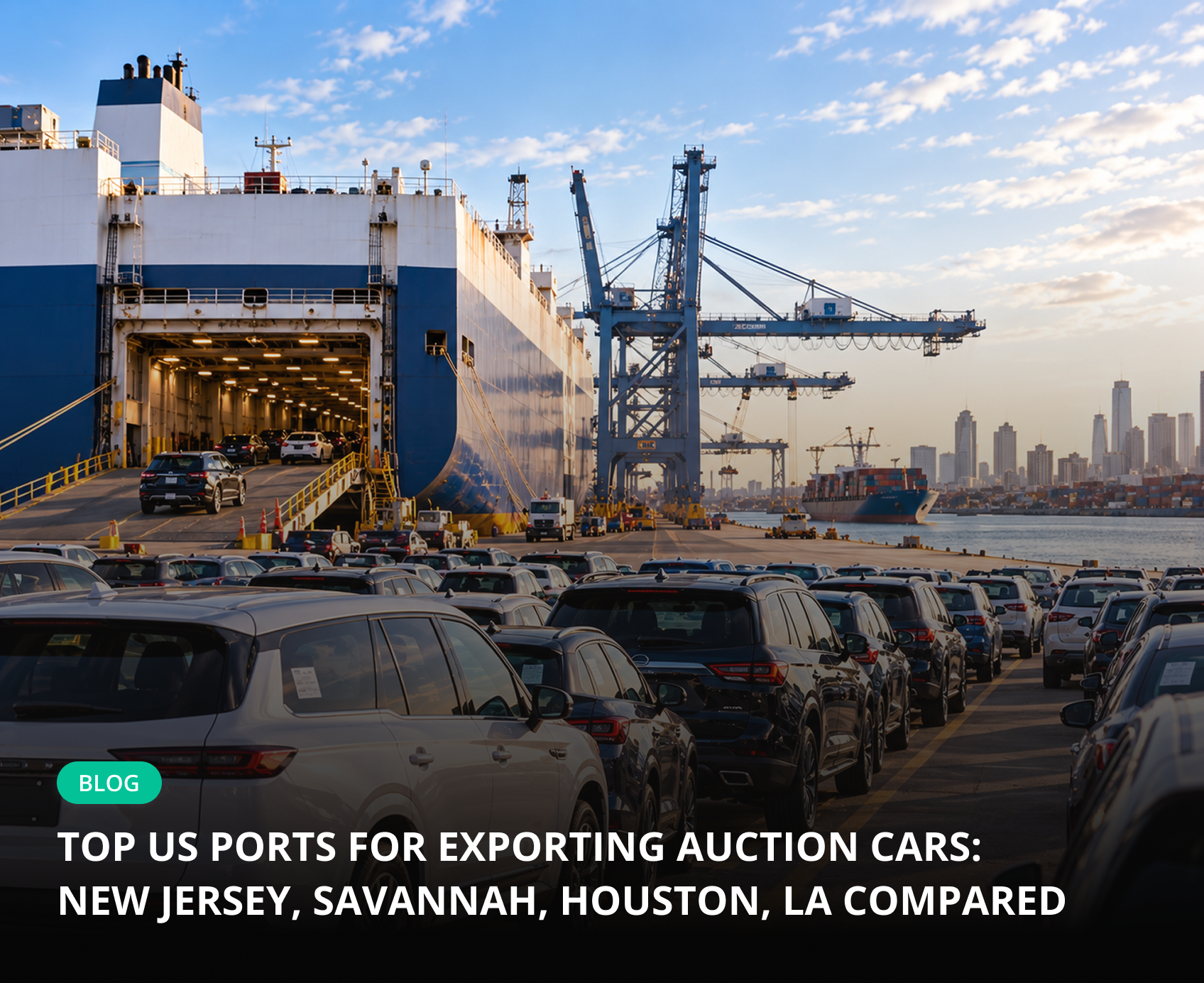
For shipping car overseas from a US auction, the port matters as much as the ocean rate. Pick the port closest to the yard that has regular sailings to your market. In practice, that means New Jersey or Savannah for Europe and the Caucasus, Houston for the Gulf and Africa, and Los Angeles for Asia.
This guide compares the four main US car export ports for Copart and IAAI buyers: towing, routes, shipping types, paperwork and typical mistakes. It helps logistics managers, brokers and dealers plan a route before the bid, not after the win.
Why Port Choice Shapes the Total Cost of Shipping a Car Overseas
Port choice sets three of the biggest costs in an export: the tow from the yard, the ocean freight and the time the car spends waiting. A cheap ocean rate from a far port often loses to a slightly higher rate from a port 300 miles closer.
Take one route. A 2019 Honda CR-V bought at a Copart yard near Atlanta is about 250 miles from Savannah and about 870 miles from Port Newark. The longer auction to port car shipping leg adds several days and a higher carrier bill before the car reaches the warehouse.
Waiting also costs money. A car that misses one sailing may sit at the warehouse for another week or two, while the dealer's capital stays frozen.
How to Choose a US Export Port: Key Factors
The right port gives the lowest total cost to the destination, not the lowest ocean rate. Even the best US ports for car export lose their edge if the yard is far away. Compare three factors: distance from the yard, sailings to your market and the shipping types available for your car.
Distance from Auction Yard to Port and Inland Towing Cost
Inland towing is the first cost of any export, and it grows with every mile. Carriers price each route separately, so the same car can cost very different amounts to tow to two ports.
Distance also affects timing. Moving a car from the yard to the port warehouse usually takes 5–10 business days. A Chicago lot is roughly 1,000 miles from Savannah, while a Dallas lot is only about 240 miles from Houston.
Ocean Routes, Transit Time and Destination Markets
Each port specializes in certain trade lanes. East Coast ports serve Northern Europe, the Baltics, the Black Sea and the Persian Gulf. Gulf ports add West Africa and Latin America, while West Coast ports face Asia and Oceania.
Transit time is the number of days from loading to arrival at the destination port. New Jersey to Klaipeda usually takes about 16–22 days, while Houston to Klaipeda takes about 22–28 days. A weekly service also loses less time than a bi-weekly one.
Container vs RoRo Shipping Availability
The container vs RoRo car shipping choice depends on both the car and the port. RoRo shipping means the car is driven onto a special vessel and parked on a deck. In container shipping, the car is loaded into a steel box, often together with other vehicles.
Most RoRo lines prefer running cars that can be driven aboard, so non-running and heavily damaged lots usually go in containers. RoRo cargo is also often insured only for total loss, while containers allow photo inspection at the warehouse.
Top US Ports for Exporting Auction Cars
For auction buyers, the best US ports for car export are those where forwarders run consolidation warehouses. There, containers are loaded several times a week, and each route has its own price list.
Port Newark, New Jersey: East Coast Hub for Europe, the Caucasus and the Middle East
Port Newark is the default choice for yards in the Northeast and the Midwest. It offers frequent sailings to Bremerhaven, Rotterdam, Klaipeda, Poti and Jebel Ali. Many forwarders that serve Ukraine, Poland, Lithuania and Georgia run their own warehouses in New Jersey.
For Northeast lots, the usual plan is simple: tow to a New Jersey warehouse, consolidate, then ship car from New Jersey port terminals within a week or two. The downside is congestion and higher local handling at peak times.
Savannah, Georgia: Lower Handling Fees for Southeast Auctions
Savannah is the logical port for yards in Georgia, the Carolinas, Florida, Alabama and Tennessee. Forwarder price lists often show lower port handling for Savannah than for New Jersey, and the short tow adds to the savings.
Container service from Savannah reaches the Baltics, the Black Sea and the Gulf. East Coast sailings to Poti take roughly 25–35 days, so Savannah suits buyers in Georgia, Armenia and Azerbaijan as well as Europe.
Houston, Texas: Gulf Gateway for West Africa, the Middle East and Latin America
Houston serves the large Copart and IAAI yards in Texas, Oklahoma, Louisiana and the Southwest. It has direct lines to Jebel Ali, Lagos, Cotonou and Central America. That makes it the main port for buyers in the UAE, Nigeria, Honduras and Guatemala.
For Texas lots, auction to port car shipping to Houston is a short, cheap haul. For Europe, Houston is slower: Baltic sailings are often bi-weekly, and the ocean leg takes about a week longer than from the East Coast.
Los Angeles and Long Beach: Pacific Gateway for Asia and Australia
Los Angeles and Long Beach handle cars from California, Arizona, Nevada and Utah. Main routes run to South Korea, Japan, Australia and New Zealand, which makes them the natural choice on the Pacific side.
For Europe or Georgia, West Coast departures are the slowest and usually the most expensive. The ocean leg to Poti alone can take 35–45 days, so forwarders often tow West Coast lots east instead.
Other Options: Baltimore, Brunswick, Jacksonville and Seattle
Smaller ports can also work for auction cars. Baltimore is a strong RoRo port for the Mid-Atlantic. Brunswick, Georgia, handled 779,000 vehicles in 2025 and was the busiest US auto port, mostly on RoRo services.
Jacksonville links Florida yards with the Caribbean and Latin America, while Seattle and Tacoma serve Asian routes. These ports fit when the yard is nearby and a forwarder sails there regularly.
Port Comparison Table: Routes, Shipping Types, Transit Times and Costs
The table below shows how the four main ports compare for auction buyers. Transit times are typical ocean legs without towing or customs.
| Port | Main markets | Shipping types | Typical transit time | Best fit |
| Newark, NJ | Northern Europe, Baltics, Black Sea, Gulf | Container, RoRo | Klaipeda 16–22 days | Ship car from New Jersey port for Northeast and Midwest yards |
| Savannah, GA | Baltics, Black Sea, Gulf | Container, RoRo via Brunswick | Klaipeda 18–24 days, Poti 25–35 days | Southeast yards, lower port handling |
| Houston, TX | West Africa, Gulf, Latin America | Container, RoRo | Klaipeda 22–28 days, Poti 30–40 days | Texas yards, pickups and large SUVs |
| Los Angeles / Long Beach, CA | Asia, Australia, New Zealand | Container, RoRo | Poti 35–45 days | West Coast yards, Pacific routes |
Across all US car export ports, the closer the yard, the cheaper the total route, unless the port lacks sailings to your market. A shared container from the East Coast to Klaipeda often costs about $1,500–$2,200 per car. Rates change monthly, so check the current price list.
Export Paperwork and Deadlines: Title Cut-Off, AES Filing and Customs
A car leaves the US only after customs receives the original title and the export filing. US Customs and Border Protection (CBP) needs both at the port at least 72 hours before export.
A title cut-off is the date by which the forwarder must hold the original title to book a specific sailing. Copart and IAAI titles can take days or weeks to arrive. AES is the US Automated Export System for electronic export filings.
The export paperwork usually follows this order:
1. The buyer pays the auction invoice and receives the vehicle release.
2. Copart or IAAI mails the original title to the buyer or the forwarder.
3. The freight forwarder receives the title before the title cut-off.
4. The forwarder files the export data in AES and receives an ITN (Internal Transaction Number).
5. The title and ITN go to CBP at least 72 hours before loading.
Every used vehicle needs an AES filing, whatever its value or condition. Late or missing filings can cost up to $10,000 in penalties.
Common Mistakes When Shipping Auction Cars Overseas
Most expensive mistakes happen before the car reaches the port. Buyers who search how to "ship car overseas from auction" yards usually compare ocean rates. Most of the risk, however, sits in towing, titles and timing.
The most common mistakes on auction exports are these:
- Buying a lot whose title document cannot be exported.
- Choosing the cheapest ocean rate without counting extra towing miles.
- Booking a RoRo slot for a non-running car that needs a container.
- Missing the title cut-off because the auction title arrived late.
- Quoting the client a price without port handling and destination fees.
Each error adds hundreds of dollars or weeks to one car, so check the document type, the yard and the port before the bid.
How AuctionGate Shows Delivery Costs Right on the Lot Page
For a logistics company, the hardest part is quoting the full price before the auction ends. Managers often add towing, freight and customs by hand in Excel.
AuctionGate turns that work into a delivery price list for each client. It follows the chain auction → warehouse → freight → port → car hauler → customs and covers vehicle types such as sedan, SUV, pickup or motorcycle. Extra services, including hazardous cargo fees for hybrids and EVs, can be added too.
The free AuctionGate Chrome Extension shows this full price right on the Copart and IAAI lot page. It adds purchase, delivery and customs by the client's personal price list, so the client sees the cost to Klaipeda or Poti in about 30 seconds.
The extension also shows whether the document type allows export. For one car a year, a spreadsheet is enough, but dozens of lots a month need a system.
Conclusion
The best port gives the lowest total cost, not the lowest ocean rate. Shipping car overseas from US auctions works best when the yard, the port and the market are planned together before the bid.
New Jersey and Savannah cover most routes to Europe and the Caucasus. Houston serves the Gulf, West Africa and Latin America, while Los Angeles faces Asia. Title timing and the AES filing decide whether the car makes its vessel.
For companies buying for many clients, auction account management in AuctionGate keeps accounts, bids, invoices and delivery prices in one place.
FAQ
Q1: What Is the Cheapest US Port to Ship a Car Overseas?
A: Usually the port closest to the auction yard with regular sailings to your market. For Southeast yards that is often Savannah, for the Northeast it is New Jersey, and for Texas it is Houston. A cheaper ocean rate from a distant port rarely covers the extra inland towing miles.
Q2: How Long Does It Take to Ship a Car from the US to Europe?
A: Usually about 4–7 weeks from the auction win to arrival. Towing to the port takes 5–10 business days, and the ocean leg from the East Coast to Klaipeda or Bremerhaven takes about 16–24 days. Title delays and waiting for container consolidation can add one or two weeks.
Q3: Is Container or RoRo Shipping Better for Auction Cars?
A: Containers are better for most auction lots. They accept non-running and damaged vehicles and allow inspection photos at the warehouse. In the container vs RoRo car shipping decision, RoRo wins only for running cars that are oversized or urgent. Its insurance often covers total loss only.
Q4: How Many Cars Fit in One 40-Foot Container?
A: Usually up to four sedans fit in a 40-foot high cube container loaded on racks. Pickups and large SUVs take more space, so a container may hold only two or three of them. Sharing one container with other buyers lowers the freight cost per car.