 AuctionGate.io







Multi Auction Integration for Dealers: What It Means and How It Transforms Operations
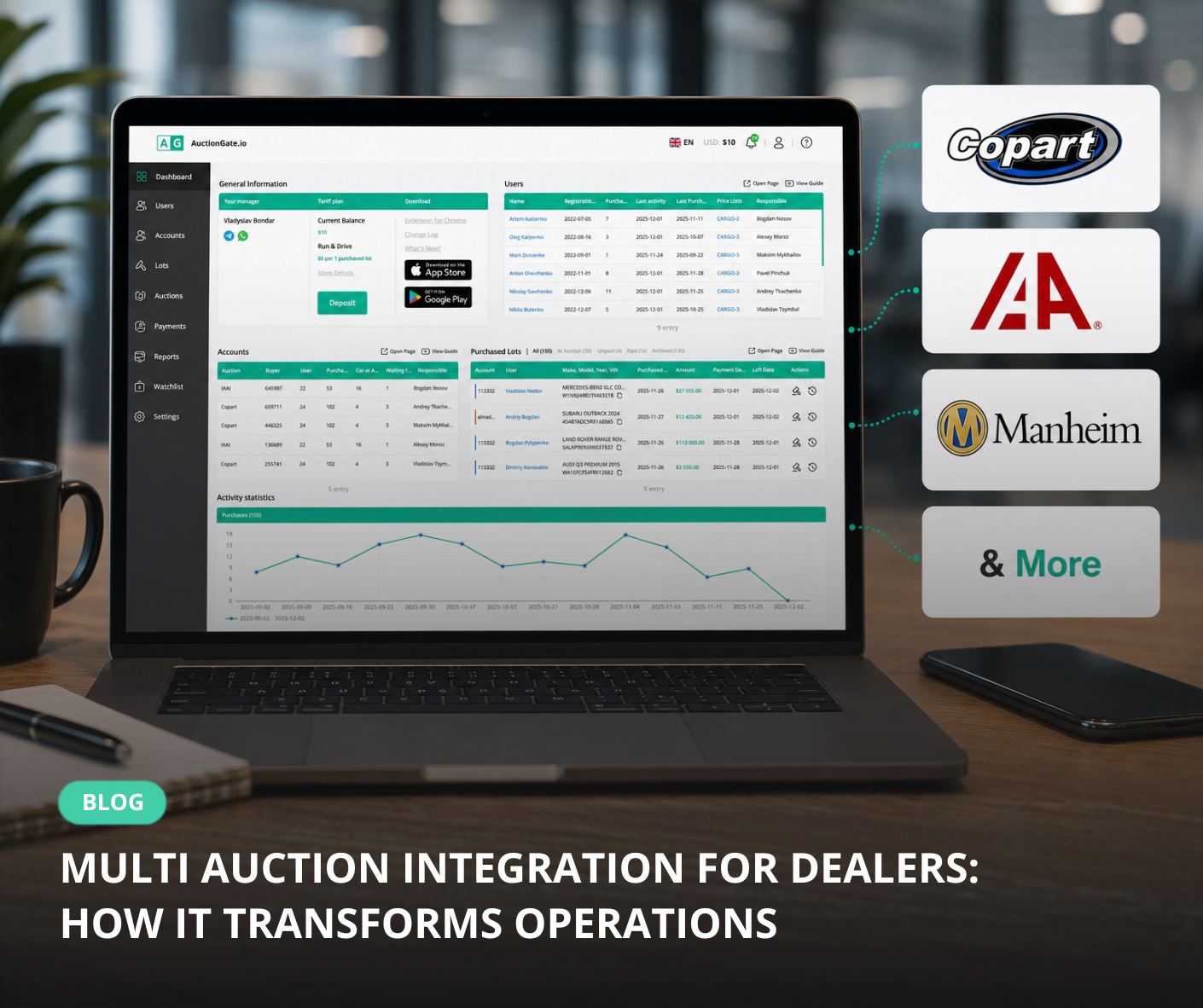
Understanding multi auction integration is one of the most important operational skills any dealer or high-volume buyer can develop. Whether you're managing a handful of bids across two platforms for the first time or scaling a professional multi-platform sourcing operation, this guide covers everything that matters: how auction software integration actually works, how it affects dealer efficiency and profitability, what technical and organizational barriers exist, and how to use platforms like AuctionGate to make disciplined, data-driven sourcing decisions across both Copart and IAAI.
What Is Multi Auction Integration?
Multi auction integration meaning in practical terms: it is a unified operational layer that connects multiple auction platforms — most commonly Copart and IAAI — into a single system, so that listings, bids, and results are synchronized automatically instead of being tracked manually across disconnected accounts. Historically, dealers logged into separate systems, maintained parallel spreadsheets, and relied on manual reconciliation to keep sourcing data accurate. Integration replaces that fragmented process with one continuously updated operational record. For dealers running high-volume sourcing across Copart, IAAI, or any other auction platform, integration is the single most consequential infrastructure decision in the entire buying operation.
In practice, this means secure API connections pull listings, bid status, and results from each platform into a centralized, standardized structure — and the dealer's own consolidated system becomes the single source of truth, rather than each auction's native dashboard. The trigger for adoption is usually sourcing across two or more platforms simultaneously, rising bid volume, or a growing team; any of these makes manual tracking unsustainable. Once connected, synchronization is continuous, so there's no need for repeated logins, manual exports, or duplicate data entry.
The meaning of multi auction integration extends beyond simple convenience. A dealership may be fully capable of winning bids manually and still lose money to inefficiency if reconciliation errors, missed status updates, or duplicate records slow down the post-purchase workflow — a situation common among growing dealerships where bid volume outpaces manual tracking capacity. Conversely, even a small-volume buyer benefits from integration the moment they source from more than one platform. This variability is precisely why evaluating integration depth — not just bidding access — is non-negotiable for any serious dealer, and why platforms that unify listing data, bid history, and shipment status alongside pricing context provide genuine operational value.
How Dealers Adopt Multi Auction Integration
The pathway from fragmented, single-platform bidding to a fully integrated multi-auction operation is a defined process that typically takes days, not months, once the right platform is selected. It begins when a dealer recognizes that manual tracking across accounts is creating errors or costing time. The dealer connects their existing auction accounts to an integration platform, typically just once. The system then pulls listings, bid status, and results continuously, standardizing the data into a consistent structure regardless of which platform it originated from. Bidding, reporting, and internal handoffs move to that unified dashboard instead of platform-native tools, and the system keeps synchronizing in real time going forward — no further manual reconciliation required. Once connected, the dealer's team operates from one dashboard instead of switching between tabs, logins, and spreadsheets — which, for most growing operations, means a permanent shift in how sourcing decisions get made. This is why integrated multi-platform tools skew heavily toward dealers who source at meaningful volume and need reliable, comparable data across auctions.
It's important to note that not every dealer needs the same depth of integration. A meaningful share of dealers adopt multi auction integration because rising bid volume made manual reconciliation unacceptable, while others adopt it because they are expanding into a second platform for the first time and want to avoid the operational chaos of parallel systems from day one. In each case, the volume profile, team size, and reporting needs differ substantially. A two-person operation sourcing occasionally and a high-volume dealer running dozens of concurrent bids may both describe their need as "integration" on paper — which is why the specific feature set and depth of data access attached to each platform are far more informative than the marketing label alone.
How Multi Auction Integration Affects Dealer Performance
Understanding how multi auction integration affects dealer performance is essential for justifying the investment. As a general benchmark, dealers who move from manual multi-platform tracking to integrated systems report significant reductions in reconciliation time and bidding errors — but the exact figure varies substantially based on team size, bid volume, platform mix, and the specific operational maturity of the dealership on a given day. Hours previously spent on manual reconciliation and spreadsheet maintenance are largely eliminated, duplicate records and missed status changes drop sharply once data flows through one synchronized system, and teams running large bid volumes retain proportionally more benefit from integration than occasional buyers. Automated, standardized reporting partially replaces manual spreadsheet work, though it doesn't fully eliminate the need for financial oversight — and even highly disciplined manual teams face a hard ceiling on how much bid volume they can responsibly manage without synchronized data.
Auction software integration reflects real operational conditions, meaning a well-organized team with disciplined workflows can extract dramatically more value from integration than a team that simply bolts on new software without changing its process. Dealers who calibrate their expectations against realistic before-and-after benchmarks — not just vendor promises — consistently make better platform decisions.
The reconciliation-error challenge is one of the most consequential factors for dealers planning to scale sourcing volume. Even with experienced staff, fragmented multi-platform tracking leaves a dealership's bid history and inventory status vulnerable to human error that compounds as volume grows. Manual processes apply a hidden time tax reflecting the uncertainty of cross-checking multiple dashboards — and larger teams face an even steeper one, since more people touching the same data multiplies the chance of conflicting records. Dealers who understand this ceiling and factor it into their growth planning — working backward from target bid volume minus the reconciliation capacity of their current tools — are the dealers who consistently scale profitably rather than scaling their error rate alongside their volume.
Multi Auction Integration at Copart vs IAAI
Both Copart and IAAI are the dominant platforms dealers integrate with for multi-auction sourcing, but they operate with meaningful structural differences. Copart's native platform is the largest in the country by volume, with 200+ US locations and a broad mix of vehicle categories, which means integration tools connecting to Copart must handle a high-volume, high-variety data feed. IAAI's native platform, while somewhat smaller at 170+ locations, is particularly noted for detailed lot documentation, which means integration tools connecting to IAAI must be able to preserve and surface that additional detail rather than flattening it into a generic format.
Both platforms require account registration, and integration tools connect to the dealer's existing credentials rather than replacing them. Both also charge buyer fees on top of winning bids; strong integration surfaces these fees clearly rather than leaving dealers to calculate them manually. Through AuctionGate, both Copart and IAAI inventory and bid data are unified in a single dashboard, allowing side-by-side comparison without switching platforms. Understanding these operational differences helps dealers decide what to prioritize when evaluating which integration platform can genuinely handle both data structures well.
The practical implication for serious dealers is that choosing an integration tool that only handles one platform well is a strategic constraint. A dealer sourcing across both Copart and IAAI needs a system that treats both feeds with equal reliability, not one that was clearly built around a single platform's data structure. Cross-platform visibility — combined with pre-bid cost estimation tools that account for auction fees, transport, and reconditioning estimates — is one of the clearest structural advantages a dealer can build into their sourcing operation. This is the core workflow that AuctionGate's multi-auction integration tools are designed to support.
Technical and Organizational Challenges
The auction software integration challenge is one of the most practically significant barriers any dealer faces when scaling beyond a single platform. A dealership running fragmented accounts cannot get a reliable, real-time view of total exposure across platforms — full stop. Before a team can operate confidently at scale, it needs synchronized data, role-based access control, and automated reporting that reflects reality rather than yesterday's spreadsheet snapshot. Fragmented accounts make it difficult to know total committed capital across platforms at any given moment, and scaling a team requires role-based permissions and bid limits rather than shared logins across staff. API access requirements, data structure, and update frequency also differ by auction platform, so compatibility should always be verified before committing.
Even after basic integration is in place, some organizational challenges remain. Many growing dealerships underestimate the training and process discipline required to get full value from an integrated system, citing the residual uncertainty about who is responsible for which step. Most dealerships get only partial benefit from integration tools if internal workflows aren't adjusted to match, while those who invest in proper onboarding typically extract meaningfully more value — and reach time-to-value meaningfully faster — than those who treat integration as a plug-and-play afterthought.
Dealers who skip the process-alignment step before adopting integration frequently discover post-implementation that their team is still doing manual work in parallel, or that the platform's reporting doesn't map cleanly onto their existing accounting workflow. Confirming the availability and depth of role-based access, automated reporting, and platform compatibility for your specific sourcing mix is not optional pre-adoption research — it is a foundational input into the true total cost of running an integrated sourcing operation. Explore the AuctionGate dealer resources library for platform-by-platform integration and onboarding guidance.
When Multi Auction Integration Makes Sense
Despite the genuine setup effort, the decision to adopt multi-platform auction tools is strategically sound for a well-defined set of dealers and use cases. The core operational logic is straightforward: the gap between the time and error cost of manual multi-platform tracking and the efficiency of a synchronized system — or the opportunity cost of bids missed due to fragmented visibility — is where the return on integration lives. Dealers running many concurrent bids across platforms are the clearest beneficiaries of integration, as are growing teams where multiple staff members bid or track inventory and need centralized, role-based access. Buyers who regularly compare similar lots on Copart and IAAI need unified data to do it efficiently, dealers who rely on performance data to guide sourcing budgets need standardized, automated reports, and dealerships planning to grow bid volume benefit from infrastructure that scales without multiplying headcount proportionally.
Dealers who can accurately estimate their current reconciliation overhead, navigate the account-linkage process, and maintain disciplined workflows on top of their new system consistently outperform manual-tracking peers in sourcing efficiency. The manual-tracking vs integrated-system spread is the key metric for growth-focused dealers: the difference between the hours and error rate of manual reconciliation and the throughput of a synchronized system — net of onboarding and subscription costs — defines the real return. Dealers who model this spread accurately before adopting a platform, rather than reacting to bidding chaos in real time, make consistently better decisions. The discipline of pre-adoption workflow modeling is what separates efficient multi-platform operations from costly, error-prone ones.
How to Move From Fragmented Accounts to Full Integration
The transition from fragmented, single-platform habits to full multi-auction integration is a defined operational pathway available to dealers at any scale, though the specific steps vary depending on team size and existing tools. The process transforms a dealership from reactive, spreadsheet-dependent bidding to a proactive, data-backed sourcing operation — directly recovering the time and accuracy previously lost to manual reconciliation. For dealers who source across Copart and IAAI with the intention of scaling, this transition is the core efficiency-creation step and must be planned thoroughly before committing to any single tool.
- Step 1 — Audit current workflow: Document exactly how bids, listings, and results are currently tracked across platforms.
- Step 2 — Platform selection: Choose an integration tool with confirmed, reliable support for every auction platform in your sourcing mix.
- Step 3 — Account connection: Link Copart, IAAI, and any other relevant accounts, verifying that data flows correctly on both sides.
- Step 4 — Team onboarding: Train staff on the unified dashboard and assign role-based access before scaling usage.
- Step 5 — Ongoing optimization: Review reporting regularly to refine bidding strategy and confirm the integration is delivering measurable time and accuracy gains.
Successfully completing the transition to full integration substantially improves a dealership's operational position. An integrated sourcing operation is faster, more accurate, and generates meaningfully better decision-making data than a fragmented, manual one. The permanent record created by the integration — synchronized bid history, standardized reporting, and a single source of truth — provides an operational trail that experienced dealers actually value as evidence of a mature, scalable process. For operators running high-volume sourcing pipelines, standardizing this workflow is a competitive advantage that directly supports faster, more profitable buying decisions.
How AuctionGate Helps Dealers Integrate Multi-Auction Sourcing
Effectively sourcing across Copart and IAAI requires more than a bidder registration on each platform. Professional dealers need cross-platform lot aggregation, pre-bid cost estimation incorporating auction fees and transport, access to historical pricing data for comparable lots, and a pipeline management layer to track active bids, won lots, and shipment status. AuctionGate provides exactly this infrastructure in a single purpose-built interface, accessible to dealers at any scale — from individual buyers to high-volume dealer operations:
- Unified inventory view — browse Copart and IAAI lots side by side in one interface instead of switching platforms.
- Pre-bid cost calculator — estimate the true total cost per lot (winning bid + auction fees + transport) before committing.
- Historical price data — calibrate bids against actual auction price trends for comparable lots across both platforms.
- Role-based access — manage permissions and bid limits across your team from one place as your operation grows.
- Pipeline management — track bids, won lots, and shipment status across both platforms simultaneously.
AuctionGate is available today in viewing mode — meaning dealers can analyze Copart and IAAI inventory, compare lots, and build sourcing strategies without any financial commitment. This is particularly valuable for dealers evaluating multi-auction integration for the first time, or for established operations looking to test the platform before integrating it into their full workflow. The viewing mode provides real market data — actual lot conditions, actual pricing, actual fee structures — that no amount of research elsewhere can fully replicate.
Conclusion
Multi auction integration encompasses far more than convenient bidding — it is an operational, financial, and organizational framework that shapes every decision from initial sourcing strategy to final inventory turnover. Dealers who understand how integration affects performance, navigate the technical and organizational challenges proactively, and use disciplined pre-adoption workflow modeling across Copart and IAAI sourcing consistently make better decisions and generate better returns. The transition from fragmented accounts to full integration provides a clear route to operational efficiency — and platforms like AuctionGate provide the data infrastructure to source, evaluate, and execute on multi-auction opportunities with the clarity and confidence that profitable dealer operations require.
Ready to manage multiple auctions from one interface? Create your free AuctionGate account today and get instant access to a unified vehicle inventory, a total cost calculator, and historical price data. No commitment required.
FAQ:
Q1: What Does Multi Auction Integration Mean in Practical Terms?
А: Multi auction integration meaning in practice is this: the dealership operates from a single, continuously synchronized system that pulls listings, bids, and results from every connected auction platform automatically. This synchronization cannot be replicated by manually checking multiple dashboards — it is a structural feature of the integration layer itself, and it updates in real time regardless of which platform the underlying activity originated from. In practical terms, it means a dealer's team no longer needs separate logins, parallel spreadsheets, or manual cross-checking to know the true status of every bid and every piece of inventory. It means fewer duplicate records and fewer missed status changes, because the data only lives in one place. It means dealers and their finance teams can rely on standardized, automated reporting instead of reconciling exports from multiple sources by hand. And it means that scaling bid volume or team size no longer multiplies operational risk in the same way it would under a fragmented, manual setup. Understanding the full scope of these practical implications — not just the definition — is what separates dealers who adopt integration successfully from those who discover the operational gaps only after volume has already grown past their manual capacity.
Q2: How Does Multi Auction Integration Affect Dealer Efficiency?
А: Multi auction integration is one of the most consequential practical levers for any dealer's operational efficiency. A fragmented, single-platform-at-a-time workflow makes it difficult to bid confidently at scale — full stop — because the team is spending time on reconciliation instead of sourcing strategy. After integration, efficiency gains extend across the entire workflow, from bidding decisions made with comparable cross-platform data, to faster handoffs to logistics and accounting once a lot is won. Many dealerships — including some of the highest-volume operations — report that the time savings alone justify the investment, even before accounting for the reduction in costly reconciliation errors. Platforms that offer full cross-platform integration typically deliver meaningfully faster time-to-decision than those that only aggregate surface-level listing data. Some integration tools offer deeper reporting and pipeline management than others, but availability of true real-time synchronization is not uniform across vendors. The practical implication for dealers is clear: before committing to any integration platform, confirm specifically what level of synchronization, reporting, and access control is available for your exact platform mix, and at what cost. This is not ancillary research — it is a direct input into the true total cost of running a scalable sourcing operation and must be factored into the platform decision.
Q3: What Is the Difference Between Basic Auction Aggregation and Full Integration?
А: The aggregation vs full-integration distinction is the most operationally important differentiation in the multi-platform tooling context. Basic aggregation typically means a tool displays listings from multiple platforms in one place but stops there — bidding, reporting, and account management still happen separately on each native platform. Full integration means the dealer's bidding activity, results, and inventory status are actually synchronized across platforms in real time, with centralized reporting and access control layered on top. The aggregated-only setup can be registered and used quickly, but it does not meaningfully reduce reconciliation work — it only makes the fragmented data easier to view. The critical point is that surface-level aggregation does not eliminate the underlying manual-tracking burden — it is a partial solution that looks like a full one at first glance. Both approaches offer some improvement over pure manual tracking, but the efficiency gap between them is substantial because full integration is operationally validated by continuous data flow rather than a periodic refresh. For dealers calculating the return on an integration investment, understanding the aggregation vs full-integration spread — and accurately estimating the ongoing manual work required to close the gap under a basic tool — is the foundational operational model of any successful multi-platform sourcing strategy.
Q4: How Does Multi Auction Integration Affect Long-Term Dealer Profitability?
А: The multi auction integration impact on long-term profitability is measurable and compounds over time, and it must be incorporated into every growth-planning calculation. As a general benchmark, dealers who move from manual tracking to full integration report meaningful reductions in both time cost and error-driven losses — though the exact range is wide because the realized benefit depends on bid volume, team size, and how disciplined the underlying workflow was even before integration. A well-organized dealership adding integration on top of already-strong processes may see efficiency gains concentrated in reporting and scale, while a dealership replacing chaotic manual tracking may see dramatic reductions in costly bidding mistakes and missed inventory updates. After full onboarding and process alignment, a portion of the initial learning-curve cost is recovered — typically bringing the dealership to a stable, meaningfully more efficient operating state within the first few sourcing cycles. However, the ceiling on manual-tracking efficiency is permanent: even a highly disciplined manual team will eventually hit a volume level where reconciliation errors and missed opportunities become unavoidable without synchronized data. Dealers apply this lesson because growth without infrastructure simply relocates the inefficiency rather than removing it. Competitors apply it because their own sourcing teams are already operating with integrated data and unified visibility. For dealers building high-volume sourcing operations, modeling the realistic efficiency ceiling of manual tracking — not optimistic best-case assumptions about how long a spreadsheet-based process can scale — is the discipline that separates consistently profitable dealer operations from those that plateau or fall behind.